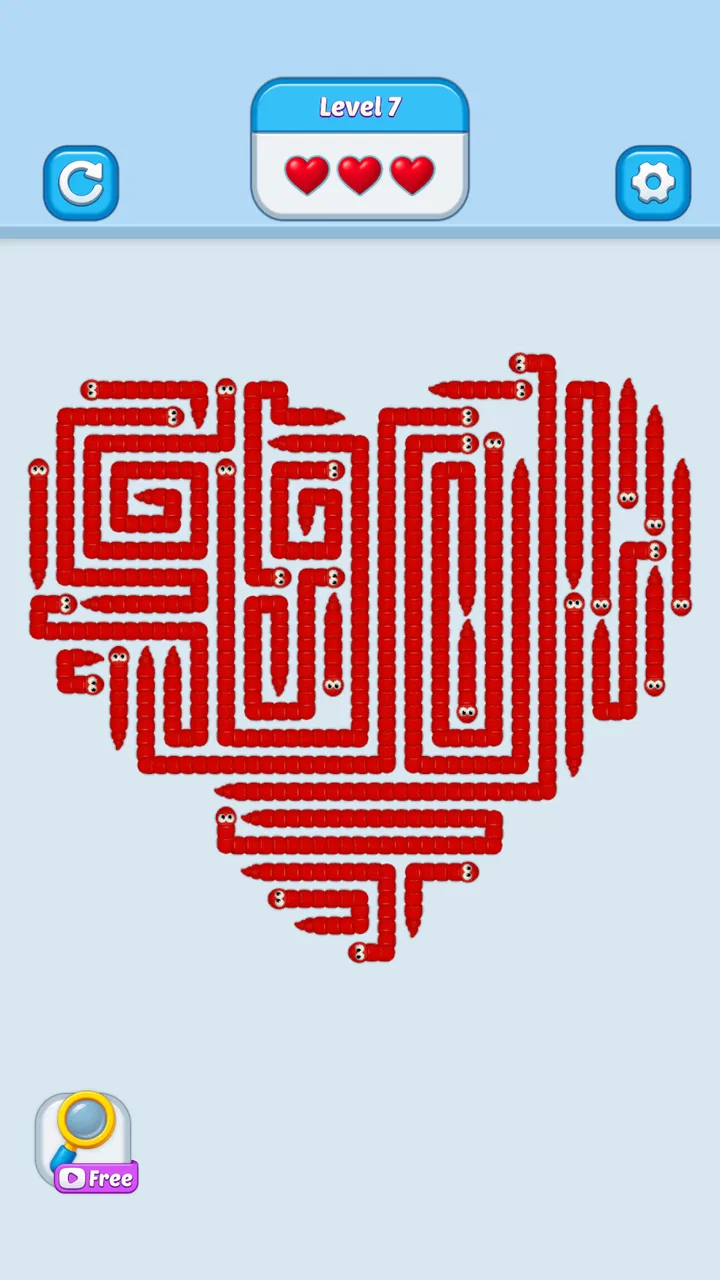
Wiggle Escape: Snake Puzzle
- 4.7
- Rating
- 5.00M
- Installs
- Free
- Price

 Analysis by App-foxy
I went into Wiggle Escape: Snake Puzzle expecting a familiar snake-style puzzle, but its appeal is less about chasing a high score and more about making one clean decision at a time. The game turns movement into a compact escape problem: I look at the board, decide how the snake should wiggle through it, watch the result, and then try again when my first idea does not work. That simple rhythm makes it an easy game to pick up during a short break, while the later thinking can become surprisingly absorbing.
This is a free puzzle game from Paxie Games, aimed at Everyone and available for devices running Android 9 or later. It has reached over five million installs and holds a 4.7 average from around 110 thousand ratings, which gives a useful sense of how broadly it has connected with players. The current version is 1.4.0, and optional in-app purchases range from $1.99 to $99.99 per item. Those details matter because the game is easy to try without paying, but players who dislike purchase prompts or any form of monetization should approach it with that in mind.
How the first move sets the whole puzzle in motion
The first action in each puzzle is usually the most important one. I do not treat the board like an arcade screen where quick reactions are the main skill. Instead, I study the available space and think about where the snake’s body will be after the move. A path that looks open at the start can become unusable once the tail follows behind, so the challenge comes from planning movement rather than simply pointing toward the exit.
You May Also Like

 Blood Strike: 2.5 Anniversary
Blood Strike’s Loadouts Turn Every Drop Into a Tactical Gamble
A close look at Blood Strike’s custom loadouts: how fast access to signature weapons reshapes its battle royale rhythm, rewards preparation, and narrows the gap between fights.

 Pandora - Music & Podcasts
Pandora’s Music Is Easy to Start, but Harder to Recover
Pandora’s strength is its low-effort path from a seed to a station. Its weak spot is how much confidence it asks you to place in connection, setup, and quiet recovery.

 8 Ball Pool
 Is Built on Rivalries, Rematches, and Routine
A close look at the rivalries, rematches, shared routines, and unanswered safety questions that turn a quick pool match into a persistent mobile community.

 Samsung Music
’s Quiet Strength Is Playing What You Already Own
Its reach comes less from spectacle than from dependable access to a personal library. That simplicity is both the app’s strongest retention engine and its ceiling.

 AccuWeather: Weather Radar
AccuWeather Review: A Quick, Clear Forecast for Everyday Decisions
For everyday plans, the best forecast is the one you can understand quickly. AccuWeather makes rain timing, radar, and local conditions easy to act on, with a few trade-offs.

 Hill Climb Racing
Why Hill Climb Racing Still Turns Crashes Into One More Run
A tiny car, a bumpy hill and one more upgrade: Hill Climb Racing keeps resurfacing because its simple chaos makes every near-miss feel personal.
More From Our News Desk



That makes the opening seconds feel deliberate. I choose a direction, commit to it, and immediately learn whether my mental picture of the board was accurate. The game’s central idea is easy to understand, but the consequences of a small mistake are what give it character. I may be trying to reach a clear route, yet the real question is whether the snake can occupy that route without blocking its own escape.
This is also where the game differs from a conventional endless snake game. There is no need to keep moving forever or protect a growing score as the main objective. The board presents a contained problem, and I can focus on solving that problem. For players who enjoy sliding puzzles, pathfinding challenges, or compact logic games, that distinction is important. It feels closer to arranging a route than surviving a reflex test.
I found it helpful to make the first move with a specific purpose. Sometimes I want to open a corridor; sometimes I need to preserve room for the body to turn later. Moving without that purpose often produces a dead end, while a cautious first step can reveal the shape of the solution. The best opening move is not always the fastest-looking one; it is the one that leaves enough options for the next decision.
The feedback rhythm keeps mistakes useful
Wiggle Escape becomes enjoyable because every action gives immediate feedback. I can see whether the snake has gained space, created a blockage, or moved into a position that will be difficult to recover from. That feedback is more valuable than a long explanation because the board itself teaches the rules. After a few attempts, I begin to recognize patterns: a narrow passage may need to be approached from a certain angle, and a tempting turn may close off the only useful route.
The rhythm is simple: act, inspect the result, and adjust. When I fail, the mistake usually feels readable rather than random. I can identify the turn where I committed too early or the space I used without considering the return path. That makes restarting less frustrating than losing progress in a long adventure game. The failure is short, and the information gained from it can be applied immediately.
One useful habit is to stop thinking only about the head of the snake. I also watch the space that the body will occupy after several moves. This prevents a common error: planning a route that works for the front but leaves the rest of the snake trapped behind it. I also try to preserve a turning area instead of filling every available gap. A route can look efficient while still being impossible to finish if it removes the room needed for the final bend.
Another practical approach is to divide the board into small sections. I first identify the likely exit direction, then work backward and ask which spaces must remain open immediately before the finish. This backward check often exposes a bad plan before I spend several moves following it. It is a small change in how I look at the puzzle, but it makes the game feel more thoughtful and less like trial and error.
The feedback is especially suitable for short sessions because the game does not require a long warm-up. I can open it, solve one board, and stop, or continue when the next puzzle makes me curious. That flexibility is one of its strongest everyday qualities. It does not demand the same uninterrupted attention as a story-driven game, but it still gives me enough mental friction to feel satisfying.
Why solving a board feels rewarding
The reward in this game is mainly the clean resolution of a problem. I enjoy the moment when the route finally works because the successful move confirms the plan I had been building in my head. The pleasure is not based on collecting a complicated set of systems; it comes from seeing a tangled position become orderly through a few correct decisions.
That kind of reward suits players who like visible progress without needing a heavy narrative. A completed puzzle gives me a clear stopping point, and the next challenge offers a reason to continue. The game’s store summary describes it as a way to relax, think, and play, and in my experience the “relax” part depends on accepting that some boards are meant to be considered slowly. It is calming when I stop rushing, but less so when I keep repeating the same failed idea.
I also like that the reward is tied to understanding rather than luck. If a solution works, I can usually see why it worked. That makes improvement feel personal: I am getting better at reading the board, not merely hoping for a favorable outcome. For someone who wants a puzzle game that can exercise spatial planning without becoming a large commitment, this is a meaningful strength.
There is a trade-off, though. Players who need constant novelty, elaborate unlock systems, or a strong sense of character progression may find the basic satisfaction too modest. The game’s appeal is concentrated in the board-solving loop. If that loop does not interest you, the free entry point will not change the underlying experience. I would recommend it to a friend who enjoys logic puzzles, but not to someone looking primarily for action, story, or competitive multiplayer.
The game can also work in a practical everyday situation. I might play it while waiting for an appointment, during a short commute when I am not driving, or after finishing a task and wanting a brief mental reset. I can attempt a puzzle, notice the mistake, and either restart or put the phone away. That clear boundary is more convenient than a game that punishes leaving mid-session or requires me to remember a complicated objective.
Resetting turns failure into another attempt
Resetting is central to the experience because the game’s puzzles are built around refinement. When a route collapses, I do not need to treat the failed attempt as wasted time. I can immediately reconsider the first move, change the order of turns, and test a different approach. The reset creates a compact learning cycle: the board stays familiar, but my understanding of it improves.
I recommend resetting as soon as I recognize that the remaining position cannot lead anywhere useful. Continuing to push a blocked plan only makes the session feel tedious. A quick restart is better because it preserves the game’s mental pace. I also try not to repeat an attempt without changing something specific. If I take the same opening and make the same turns, I am not really testing a new solution.
This is where the game’s design can be both welcoming and demanding. The short reset loop makes it accessible to casual players, but the responsibility for learning sits with me. The game does not need to overwhelm me with instructions because the board explains the consequence of each choice. On the other hand, players who prefer generous hints or a clearly marked solution path may find the self-guided process less comfortable.
For a better session, I use a three-step routine. First, I scan for the spaces that must remain available. Second, I choose a route that leaves room for the body rather than only the head. Third, after a failed attempt, I change the earliest questionable decision instead of adjusting only the final move. This approach makes resets informative and helps prevent the feeling that I am guessing.
The reset also changes how I measure progress. I do not judge a session only by the number of puzzles completed. Sometimes I finish with a better understanding of how the snake occupies space, even if one board remains unsolved. That is a useful quality for a puzzle game intended to be played casually: a short attempt can still feel worthwhile when it produces a clearer plan for next time.
Where it fits among puzzle alternatives
Compared with a match-three game, Wiggle Escape asks for more planning and less pattern spotting under time pressure. A match-three title is often better when I want bright, rapid feedback and a low-effort distraction. This game is a stronger choice when I want to think through consequences and enjoy the satisfaction of a route that has to be constructed carefully.
Compared with a traditional sliding-block puzzle, it offers a different kind of spatial challenge. Sliding puzzles usually focus on rearranging pieces until a target layout appears, while this game makes movement and body placement the central concern. I find it more immediate because each move changes the route in a way I can see at once. Someone who prefers manipulating a fixed arrangement may still prefer a classic sliding puzzle, especially if they enjoy studying a board without the pressure of a moving character.
It also sits apart from an endless snake game. Endless versions are generally about speed, score, and avoiding collisions for as long as possible. Here, the contained puzzle format makes each board feel like a question with an answer. That makes it more suitable for quiet concentration and less suitable for players who want escalating speed or a leaderboard-driven challenge.
The free price lowers the barrier to trying it, but the in-app purchase range means I would still check the purchase flow before handing the device to a child. The Everyone rating makes the game broadly approachable, yet age suitability and spending comfort are not exactly the same thing. I would be comfortable recommending it as a family-friendly puzzle, while still keeping normal purchase protections enabled on a shared device.
Its audience size is another reassuring sign for someone deciding whether to test it: more than five million installs and a 4.7 average suggest that the core idea has found a substantial audience. I would not treat popularity as proof that every player will enjoy it, but it does make the game feel like a well-established choice rather than an obscure experiment. Paxie Games has focused the experience around a recognizable puzzle premise that is easy to explain in one sentence and deeper to play than that sentence suggests.
Small frictions that affect the recommendation
The biggest limitation is that the game’s simplicity can become its boundary. I enjoy the focused loop, but I would not expect it to replace a larger puzzle collection for long sessions. If I want varied mechanics, a story campaign, or a broad set of puzzle types in one download, another game may offer better value. Wiggle Escape works best when I specifically want its snake-and-escape format.
The game can also feel repetitive if I approach every board in the same way. Its depth comes from changing how I read the space, so players who rush through the obvious route may meet frustration quickly. I have to be willing to pause, visualize the body’s future position, and accept that a slower first move can be the correct one. That is a fair demand for a logic game, but it is still a demand.
Monetization is another point to consider. The game is free to start, while individual in-app purchases range from $1.99 to $99.99. I would not make a purchase simply because I was stuck on a puzzle; I would first step away, reset my approach, and return later. For me, the core loop is strongest when the solution comes from observation rather than spending. Anyone who wants a completely purchase-free environment should choose carefully before settling in.
Device compatibility is straightforward for newer phones and tablets because the minimum requirement is Android 9. That makes it accessible without targeting only the latest hardware. Still, the practical experience can depend on the device and the way a person plays: a larger screen may make board reading more comfortable, while a smaller phone can encourage quick sessions but make careful visual planning feel tighter.
Who should download it and who should pass
I would recommend this game to people who enjoy short, self-contained puzzles, especially those who like planning routes and learning from mistakes. It is a good fit for a student taking a study break, a commuter looking for a quiet distraction, or anyone who wants a game that can be played in small pieces without losing its identity. It also suits players who prefer a clear objective over an endless score chase.
I would be more cautious about recommending it to someone who needs constant action. The game rewards patience, and its most satisfying moments come after thinking rather than reacting. It is also not my first choice for a player seeking a rich story, competitive matches, or a large variety of unrelated mechanics. In those cases, a broader puzzle platform or an arcade-focused snake game would probably be a better match.
For new players, my best advice is to treat every move as a commitment but not every failure as a setback. Look beyond the snake’s head, preserve turning space, and restart once the route is clearly compromised. If a puzzle feels impossible, change the opening decision instead of forcing the same plan. Those habits reveal the game’s real appeal much faster than simply playing more quickly.
The loop verdict after repeated sessions
The action-feedback-reward-reset cycle is what makes Wiggle Escape work. I make a move, see how the snake’s position changes, learn from the result, and either enjoy the successful escape or reset with a better idea. Then another session begins because the unfinished board leaves a small, specific question in my mind: what if I had opened that space first, or saved that turn for later?
That is a modest hook, but it is an effective one. The game does not need a complicated premise to hold my attention because the board gives me an immediate problem and the reset gives me a fair chance to solve it. Its strengths are clarity, short-session convenience, and a satisfying sense of earned progress. Its weaknesses are the narrow focus, the possibility of repetition, and the need to be comfortable with optional purchases.
My overall view is positive. Wiggle Escape: Snake Puzzle is best when you want a calm logic challenge with a quick restart and a clear reason to try once more. It is free to begin, rated for Everyone, and currently presented in version 1.4.0, so it is easy to test without committing to a large game. I would recommend it to a friend who likes spatial puzzles and wants something more thoughtful than a few random taps, while making clear that its focused format will not suit players looking for action or a full-featured adventure.
FAQs for Wiggle Escape: Snake Puzzle
01What is Wiggle Escape: Snake Puzzle?
Wiggle Escape: Snake Puzzle is an engaging mobile game available on both Android and iOS platforms. It combines classic snake gameplay with challenging puzzles. Players must navigate their snake through intricate mazes, solving puzzles to progress through levels. The game features vibrant graphics, intuitive controls, and increasing difficulty, making it suitable for all ages.
02Is Wiggle Escape: Snake Puzzle free to play?
Yes, Wiggle Escape: Snake Puzzle is free to download and play. However, it may contain in-app purchases for additional features or to remove ads. These purchases can enhance the gaming experience but are not necessary to enjoy or progress in the game. Be sure to check the app store for specific details on pricing.
03What are the key features of Wiggle Escape: Snake Puzzle?
Wiggle Escape: Snake Puzzle offers a variety of features, including hundreds of unique levels, vibrant and colorful graphics, and smooth gameplay mechanics. The game provides challenging puzzles that require strategic thinking and quick reflexes. Additionally, it offers power-ups and special abilities to help players overcome difficult levels and achieve high scores.
04Can I play Wiggle Escape: Snake Puzzle offline?
Yes, Wiggle Escape: Snake Puzzle can be played offline, making it a great option for on-the-go gaming where internet connectivity may be limited. However, some features, such as in-app purchases or leaderboard updates, may require an internet connection. Check the app’s settings for more details on offline capabilities.
05What devices are compatible with Wiggle Escape: Snake Puzzle?
Wiggle Escape: Snake Puzzle is compatible with most Android and iOS devices. It requires Android version 5.0 and up or iOS 10.0 or later. It’s designed to run smoothly on smartphones and tablets, providing a seamless gaming experience. Ensure your device meets these requirements before downloading for optimal performance.
Pros
- Engaging puzzle mechanics keep players hooked.
- Visually appealing graphics enhance gameplay.
- Levels increase in difficulty
- adding challenge.
- User-friendly interface for seamless navigation.
- Regular updates introduce new content and features.
Cons
- In-app purchases can be quite frequent.
- Occasional ads disrupt the gaming experience.
- Performance issues on older devices.
- Limited offline gameplay options.
- Some puzzles may feel repetitive over time.

Wiggle Escape: Snake Puzzle
Gallery